Overview
Semgrep Supply Chain is a software composition analysis (SCA) tool that discovers and detects security vulnerabilities in your codebase introduced by open source dependencies. It can also:
- Assist with the triage and remediation of security issues
- Prevent future security issues from the introduction and use of insecure packages
- Detect malicious dependencies associated with Supply Chain attacks
- Support the enforcement of your business' open source package licensing requirements
- Generate reports and software bills of materials (SBOM) that provide a complete inventory of your open source components
Detect vulnerabilities
Semgrep Supply Chain detects security vulnerabilities in your codebase introduced by open source dependencies using high-signal rules, which are instructions Semgrep uses detect patterns in code, to determine the vulnerability's reachability.
To do this, Supply Chain first determines the list of dependencies and versions in the code, then scans your codebase using rules that specify the following information:
- The dependency versions that contain a vulnerability
- The pattern for the vulnerable code that Semgrep compares against your code
- The severity of the vulnerability
For projects with a missing or incomplete lockfile, Supply Chain's Dynamic Dependency Resolution provides a complete inventory of your project's dependencies using a combination of manifest parsing and repository integration with package managers and private registries.
The following diagram shows the relationship between a Supply Chain rule, the codebase scanned, and in this case, a lockfile:
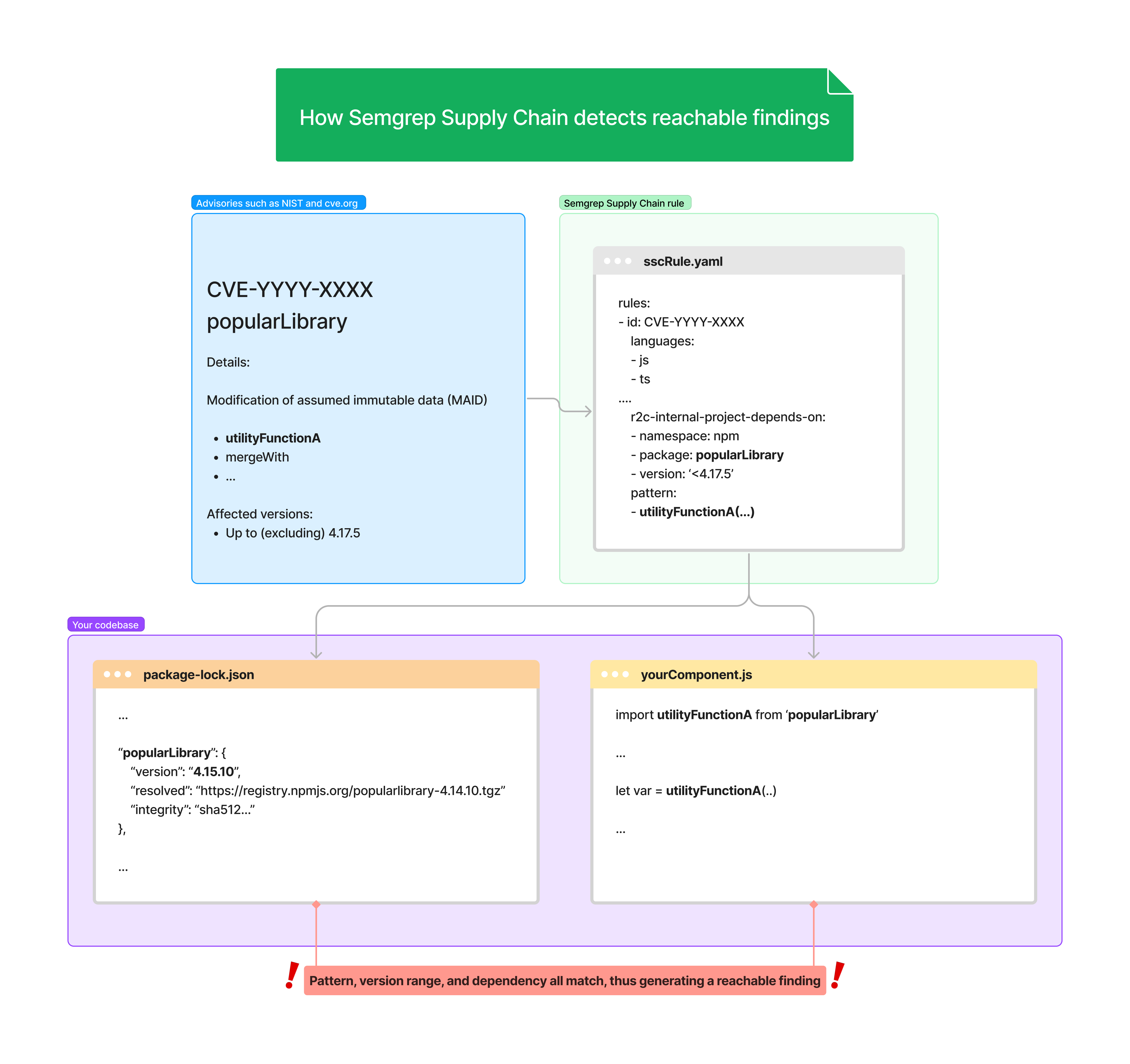 Figure. Relationship between a Supply Chain rule, manifest file or lockfile, CVE record, and codebase.
New CVEs and rule updates
Semgrep ingests CVE information and security advisories from the following sources:
Semgrep processes new information multiple times per day, ensuring a maximum lag time of no more than one hour. With this information, Semgrep:
- Generates rules for new security advisories
- Updates existing rules based on changes to security advisories
For major incidents that might affect customers, Semgrep's Security Research team ships its own advisories, even before third-party databases are updated. Semgrep processes KEVs the same way it processes other types of vulnerabilities.
Types of Supply Chain findings
Supply Chain generates a finding whenever it determines that your codebase uses or imports a package containing a vulnerability. In addition, Semgrep supports reachability for generally available (GA) languages:
- GA languages: Semgrep writes rules for all critical and high CVE severity levels for GA languages. That means Supply Chain can flag all your critical/high-severity findings as either reachable or unreachable.
- If there's a code pattern in the codebase that matches the vulnerability definition, the finding is flagged as reachable.
- A finding is always reachable if the only way to fix the vulnerability is to upgrade the dependency. Semgrep strongly recommends upgrading the dependencies involved in these findings.
- A finding is conditionally reachable if the vulnerability can be exploited when specific conditions are met. The finding is reachable if, in addition to the dataflow reachability in code, additional factors, such as the use of a specific operating system, are met. Semgrep cannot determine whether such factors are true, so conditionally reachable findings require manual review.
- If Supply Chain determines that you don't use the vulnerable library package imported or you don't use the vulnerable piece of code of the library or package imported, the finding is flagged as unreachable.
- If Supply Chain determines that you use a vulnerable version of a dependency, but Supply Chain doesn't have a relevant reachability rule, it flags the finding as no reachability analysis.
- If there's a code pattern in the codebase that matches the vulnerability definition, the finding is flagged as reachable.
- For languages where Supply Chain doesn't currently offer reachability rules languages, Supply Chain's performance is comparable to that of GitHub's Dependabot. Supply Chain generates these findings by checking the dependency's version against a list of versions with known vulnerabilities, but it does not run reachability analysis. Because Supply Chain doesn't run reachability analysis, it can't determine whether the vulnerability is reachable. Such vulnerabilities are, therefore, flagged as no reachability analysis.
Specific dependency and code match findings are called usages. Semgrep AppSec Platform groups all usages together by vulnerability. For each vulnerability, the UI also displays a CVE number corresponding to the CVE program record.
Transitive dependencies and reachability analysis
A transitive dependency, also known as an indirect dependency, is a dependency of a dependency. Supply Chain scans transitive dependencies for all supported languages, looking for security vulnerabilities, but it does not perform reachability analysis. This means that Supply Chain doesn't check the source code of your project's dependencies to determine if their dependencies produce a reachable finding in your code.
However, some dependencies are vulnerable simply through their inclusion in a codebase; in such cases, Supply Chain generates reachable findings involving these dependencies, even if they're transitive, not direct, dependencies.
Some package ecosystems allow the use of a transitive dependency as if it were a direct dependency. Though this feature is uncommon, Supply Chain can scan for such usages and flag vulnerabilities in transitive dependencies as unreachable if not used directly.
Triage and fix vulnerabilities
Once Supply Chain has identified vulnerabilities in your code and generated findings, you can take the following actions:
- Ignore findings: If the finding is a false positive, or if your company's business policies deem the use of the dependency an acceptable risk, you can choose to ignore the finding.
- Remediate true positives: If the finding is one that you must address, you can:
- Remove dependencies and refactor code: You can remediate true positives identified by Supply Chain by updating the dependency to a safe version or removing the dependency, then refactoring all usages of that dependency in your project.
- Use upgrade guidance and Autofix: If the remediation for a finding is to upgrade the package, Upgrade guidance uses program analysis and AI to analyze the results of your Semgrep scans to see if you can safely and reliably update a vulnerable package or dependency to a fixed version. Semgrep can also open a pull request (PR) or merge request (MR) that updates the vulnerable version used by your repository and guide the developer on any breaking changes in the PR or MR description.
Policies
Policies, which are scoped on a per-project basis, allow you to define the conditions that must be met for an automation action to occur. These actions include:
- Leaving a comment on the PR or MR
- Blocking the PR or MR from being merged
- Failing the build
Malware detection and response
Semgrep can detect malicious dependencies, which are treated as critical severity findings. If you have set up your policies to block critical severity findings, Semgrep prevents developers from merging pull requests or merge requests with malicious dependencies.
Supply Chain's dependency search feature allows you to query for dependencies in your codebase; it can detect direct and transitive dependencies in any repository on which you have run a full scan. The results list the dependency, along with all of the repositories that use the dependency.
Dependency paths
Supply Chain's dependency paths feature allows you to view dependency paths for all transitive dependencies introduced in a project, up to seven layers of depth. This provides information on how a transitive dependency was introduced and how deeply the transitive dependency is nested in the dependency tree.
License compliance
The license compliance feature ensures that you're only using open source packages whose licensing meets your organization's requirements.
Reporting
Reports through the Semgrep API
The Semgrep API allows you to obtain project and dependency information, as well as generate an SBOM. The following endpoints are available to you:
- List dependencies
- List repositories with dependencies
- List lockfiles in a given repository with dependencies
- Create a new SBOM export job
- Get the status of a SBOM export job
Software bill of materials
Supply Chain can generate a software bill of materials (SBOM), a complete inventory of your third-party or open source components, to assist you with your auditing procedures.
Next steps
Supply Chain automatically scans repositories that you have added to Semgrep AppSec Platform. Once your first scan is completed:
- View, triage, and remediate your Supply Chain findings.
- Customize Supply Chain to ignore files and dependencies to support your security and business goals.
- Generate a software bill of materials (SBOM).
- Query for dependencies in your codebase using dependency search.
- Ensure that you're only using open source packages whose licensing meets your organization's requirements.
Not finding what you need in this doc? Ask questions in our Community Slack group, or see Support for other ways to get help.